FIG.1 — HIGH-VOLTAGE DC DISTRIBUTION: FEWER CONVERSIONS, FEWER COPPER RUNS, NEW BATTERY RULES
The timeline is public
NVIDIA's 800 V HVDC program powers the Kyber rack — 576 Rubin Ultra GPUs per rack — with first deployments targeted for 2027, and the company demonstrated the 800V sidecar concept at GTC 2025. The supplier ecosystem is not waiting: Vertiv announced an 800VDC product portfolio shipping in the second half of 2026, and Delta — already the reference for AI power shelves — has shown an 800VDC in-row concept delivering 660 kW across six 110 kW shelves, each embedding an 80 kW battery backup bay.
Why backup batteries care
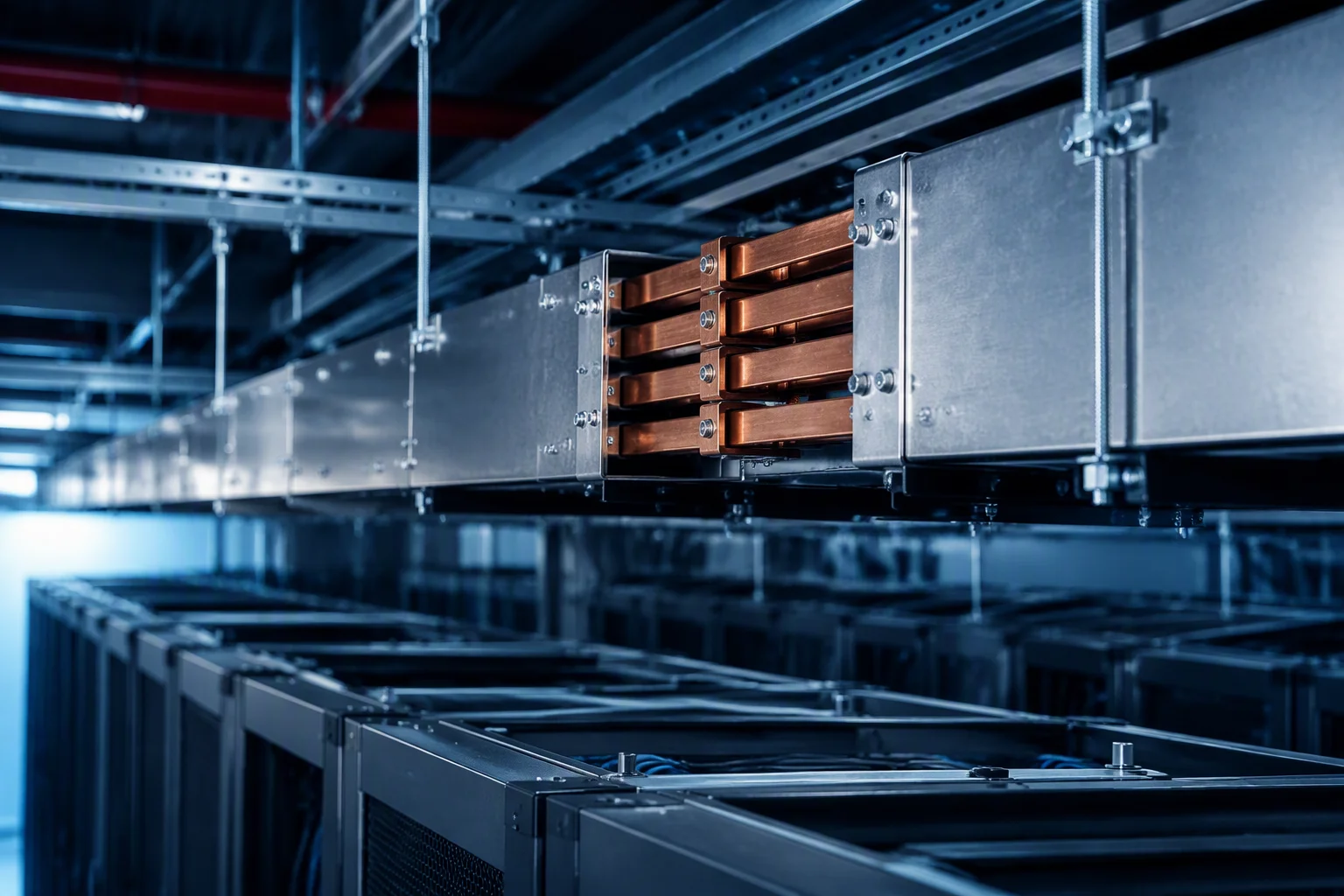
A battery doesn't care what voltage a GPU needs; it cares what voltage the bus holds. At 800 VDC, the bus is a ±400V pair — which is why the first high-voltage BBUs look like Delta's 2U 72 kW unit: a ±400VDC battery shelf with 97.5% published efficiency. Three things change for backup designers:
- Higher voltage, lower current — busbars shrink, efficiency rises, and the battery can sit closer to the load's native domain.
- Bridge electronics move from 48V MOSFET territory into isolated, higher-leverage topologies — the engineering we've reserved for HV platforms.
- Parallelism changes: fewer, larger battery shelves per bay instead of dozens of 48V units, which simplifies telemetry but raises the bar on cell-level monitoring.
The 48V world isn't ending — it's becoming the edge tier. Racks will run 800 VDC backbones with ±400V battery shelves behind them, while in-server modules keep bridging at the node. Portfolio, not platform, is the answer.
What buyers should do in 2026
If your deployment horizon touches 2027 Kyber-class hardware, require your backup vendor to show a ±400V path — not a roadmap slide, a shelf with published efficiency and thermal data. If your fleet is today's 48V racks, the rational move is still lithium: cycle life pays back long before the bus changes. That's exactly how we drew the VoltBridge line — VB-5125 for the installed -48V base, VB-H400 for the ±400V wave, one BMS telemetry language across both.
Sources
- NVIDIA Developer Blog — "NVIDIA 800 V HVDC Architecture Will Power the Next Generation of AI Factories" (Kyber, 576 Rubin Ultra GPUs, 2027)
- Vertiv Newsroom — 800VDC portfolio availability, 2H 2026
- Delta Electronics — Data-center power portfolio: 2U 72 kW BBU (±400VDC, 97.5%); GTC 800VDC in-row 660 kW display